
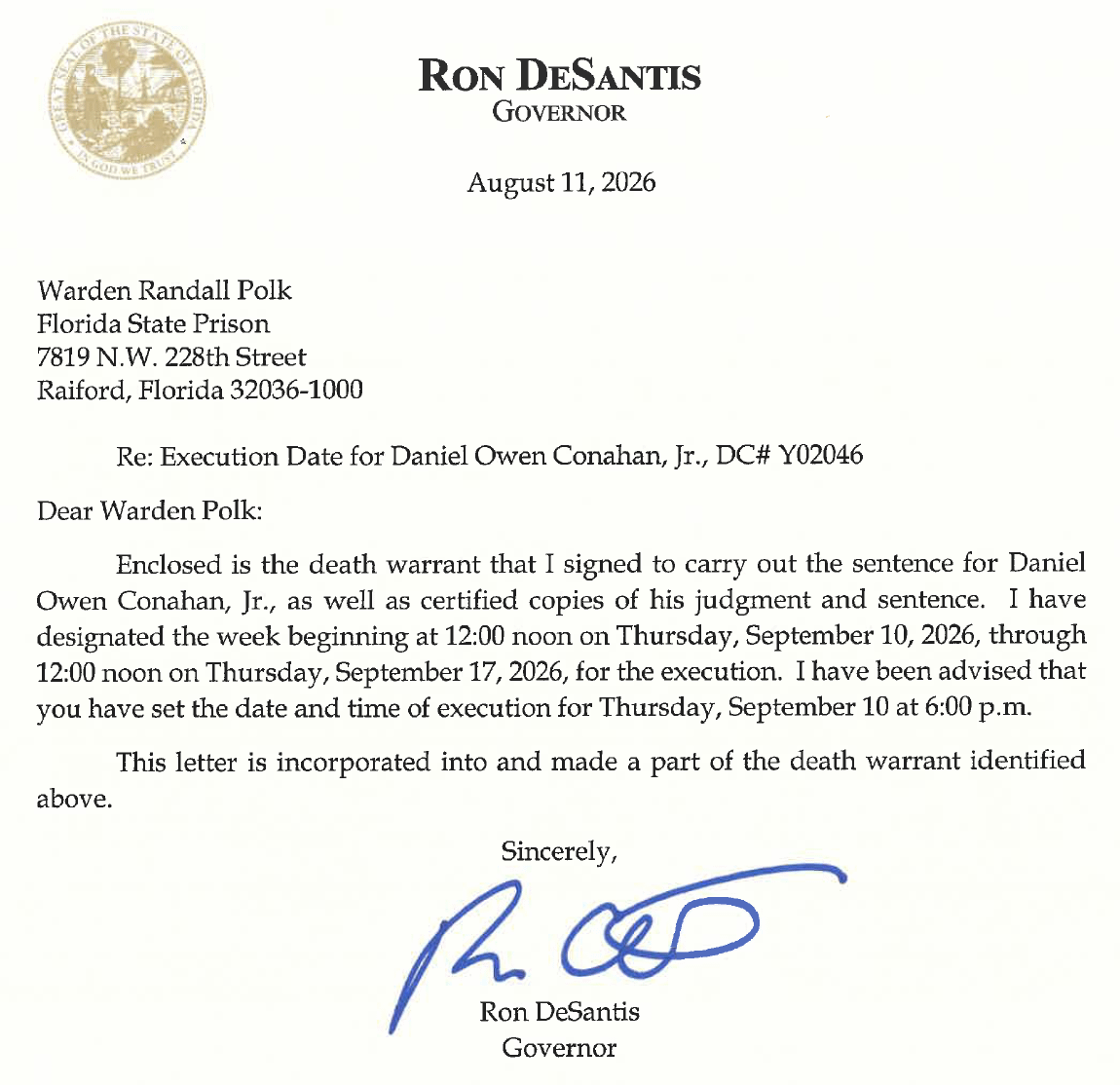
This afternoon, Gov. DeSantis signed a death warrant scheduling Daniel O. Conahan, Jr.’s execution for September 10. It is the 15th so far this year.
Scheduling Order
Shortly after the death warrant was issued, the Florida Supreme Court issued its standard scheduling order setting the following schedule for warrant litigation:
Friday, August 21, at 11:00 a.m.: circuit court proceedings completed
Friday, August 21, at 1:30 p.m.: notice of appeal and any writ petition filed
Monday, August 24, at 2:00 p.m.: initial brief due
Tuesday, August 25, at 5:00 p.m.: answer brief due
Wednesday, August 26, at 2:00 p.m.: reply brief due
Background
Conahan was convicted of killing Richard Montgomery in 1996. The Supreme Court of Florida set out the underlying facts as follows:
On April 16, 1996, Richard Montgomery, who lived with his sister, was with Bobby Whitaker, Gary Mason, and other friends when he mentioned that he was going out to make a few hundred dollars and would be back shortly. When asked whether it was legal, he smiled. Montgomery also told his mother that someone had offered to pay him $200 to pose for nude pictures, but he did not tell her who made the offer. In the same conversation, Montgomery mentioned that he had recently met the defendant Daniel O. Conahan, Jr., who lived in Punta Gorda Isles and was a nurse at a medical center. The last time friends saw Montgomery alive was on April 16 between 4 p.m. and 7 p.m.
The next day, April 17, Thomas Reese and Michael Tish, who were storm utility engineers for Charlotte County, discovered a human skull in a remote, heavily wooded area off of Highway 41 and immediately notified the police department. While searching the scene, deputies found the nude body of a young, white male that was later identified as Richard Montgomery. He had visible signs of trauma to the neck, waist, and wrists, and the genitalia had been removed. The forensic lab personnel arrived and collected various items from the scene, including a rope found on the top of a nearby trash pile, carpet padding that covered the victim’s body, a skull and a torso (neither of which belonged to the victim), a gray coat, and various combings from the victim’s arms, hands, chest, pubic area, and thighs. On the following day, Deputy Todd Terrell arrived on the scene with a K–9 dog which showed significant interest in a sabal palm tree, specifically the side of the tree which was somewhat flattened and damaged.
An autopsy revealed that Montgomery died as a result of strangulation. He had two ligature marks on the front of his neck, two horizontal marks on the right side of his chest, and abraded grooves around his wrists. All of the grooves were of similar width, did not extend to Montgomery’s back, and were consistent with marks that would be left on an individual who had been tied to a tree.
Due to the unique nature of the homicide (being tied to a tree naked and then strangled), police reviewed a similar assault reported on August 15, 1994. The victim, Stanley Burden, was a high school drop-out who, like Montgomery, had difficulty keeping a steady job and had physical features similar to those of Montgomery. The report indicated that Burden met Conahan, who offered to pay him $100 to $150 to pose for nude photographs. Burden agreed and Conahan drove him to a rocky dirt road in a secluded area where Conahan pulled out a duffle bag with a tarp and a Polaroid camera. The two men headed into the woods where Conahan laid the tarp out and asked Burden to take off his shirt and show a little hip. After taking numerous pictures of Burden, Conahan then took out a new package of clothesline so he could get some bondage pictures. He asked Burden to step close to a nearby tree and then clipped the clothesline in several pieces, draping them over Burden to make it look like bondage. Conahan moved behind Burden, snapped the rope tightly around him, pulled his hands behind the tree, placed ropes around his legs and chest, and wrapped the rope twice around Burden’s neck. Conahan then performed oral sex on Burden and attempted to sodomize him. Burden fought to position himself in the middle of the tree while Conahan tried to pull him to the side to have anal sex. After many unsuccessful attempts, Conahan snapped the rope around Burden’s neck, placed his foot against the tree, and pulled on the rope in an attempt to strangle Burden, who tried to slide around the tree to keep his windpipe open. Conahan hit Burden in the head and unsuccessfully attempted to strangle him for thirty minutes. Conahan asked Burden why he would not die and finally gave up, gathered his possessions, and left. Burden freed himself, went to a local hospital, and received treatment for his injuries. The police located the crime scene and found that one of the melaleuca trees had ligature indentions that corresponded with Burden’s injuries.
Based on this information, the police began an undercover investigation of Conahan. . . .
On May 31, 1996, pursuant to a warrant, the police searched Conahan’s residence and vehicles and obtained paint samples from his father’s Mercury Capri, which Conahan occasionally used. The police then compared paint samples from the Capri with a paint chip from the victim’s body and found that they were indistinguishable.1
Trial and Direct Appeal
At trial, “Conahan waived his right to trial by jury” for the guilt phase.2 “After a bench trial, Conahan was found guilty of the first-degree premeditated murder and kidnapping of Richard Montgomery. The penalty phase was conducted on November 1, 1999, before a jury.”3 After the penalty phase, the jury unanimously recommended death.4 The trial court then sentenced Conahan to death.
On direct appeal, Conahan raised five issues. In his first two issues, Conahan argued “that the trial court erred in denying his motion for judgment of acquittal because the State's circumstantial evidence was legally insufficient.”5 Third, Conahan argued “that the trial court erred by instructing the jury on the following two aggravating factors: (1) the murder was cold, calculated, and premeditated (CCP); and (2) the murder was committed during the course of a kidnapping.”6 Fourth, Conahan argued “that the prosecutor violated his right to a fair trial by making improper comments in both his opening and closing statements to the jury in the penalty phase of the trial.”7 The first comment at issue was the following comment by the prosecutor during his opening statement at the penalty phase:
[PROSECUTOR]: The evidence will further show that the motive, the why that this crime occurred, again, to move from the mind of the Defendant Daniel Conahan to actually say that is he began to put it into plan, put the plan into effect in 1994, that is he moved beyond a reasonable doubt thinking about this fantasy to attempting to act it out.
The evidence will show in 1994, the Defendant while cruising Lyons Park in South Fort Myers-
On appeal, the Florida Supreme Court found that the “the trial court abused its discretion when it allowed the State to comment upon Conahan's attempted murder and attempted sexual battery of Stanley Burden in its opening statement to the penalty phase jury.”8 The Court explained: “The trial court had the admissibility of that very evidence under advisement. Accordingly, it was improper for the State to comment in its opening statement upon evidence that was under advisement and which was ultimately determined to be inadmissible in the penalty phase of the trial.”9 However, the Court determined that the error was harmless and, therefore, Conahan was not entitled to relief.
As to the statements at issue in the prosecutor’s closing, the Court found no error.
Finally, for his fifth issue, Conahan argued “that the trial court violated his right to a fair trial by admitting inflammatory autopsy photos and certain photos from the crime scene.”10
The Court denied Conahan relief on all claims and affirmed his conviction and death sentence. Justice Harding concurred in part and dissented in part, writing that he did not find any error in the prosecutor’s statement during opening.
His sentence became final in 2003.
Initial Postconviction & State Habeas
“In October 2009, Conahan filed a motion for postconviction relief asserting twenty claims.”11 After an evidentiary hearing on several of Conahan’s claims in June 2010, the circuit court denied all of Conahan’s claims. Conahan appealed and filed a petition for writ of habeas corpus, arguing “that his appellate counsel on direct appeal was ineffective for failing to argue that the admission of the Williams rule evidence”—the evidence related to the Barnes crime—”was fundamental error because it was not established by clear and convincing evidence, was not sufficiently similar, and became a feature of the trial.”12
In March 2013, the Florida Supreme Court denied all of Conahan’s claims on appeal.
Federal Habeas
In his initial federal habeas petition, Conahan raised seven claims.13 He later supplemented the petition with two additional claims. In March 2023, the federal district court denied all of Conahan’s claims and also denied a certificate of appealability. In 2024, the U.S. Court of Appeals for the Eleventh Circuit also denied a certificate of appealability.
Hurst Claim
After Hurst,14 Conahan filed a successive motion for postconviction relief. However, he was ultimately denied relief due to the jury’s unanimous recommendation.
DNA Testing
According to Floridians for Alternatives to the Death Penalty, “Conahan has always maintained his innocence in this crime, and his request for additional DNA testing remains pending before the courts.”
TFDP Prior Coverage of Conahan’s Case
My thoughts are with everyone involved in the warrant- and execution-related process.
Conahan v. State, 118 So.3d 718, 724-25 (Fla. 2013) (citation omitted) (footnote omitted).
Id. at 725.
Id.
Id.
Conahan v. State, 844 So.2d 629, 634 (Fla. 2003).
Id. at 637.
Id. at 638.
Id. at 639.
Id.
Id. at 641.
Conahan, 118 So. 3d at 726.
Id. at 732.
Conahan v. Sec’y, Dep’t of Corrs., 2023 WL 264816 ( M.D. Fla. Mar 27, 2023).
For a full explanation of Hurst, see the five-part TFDP series available in the Resources tab.