
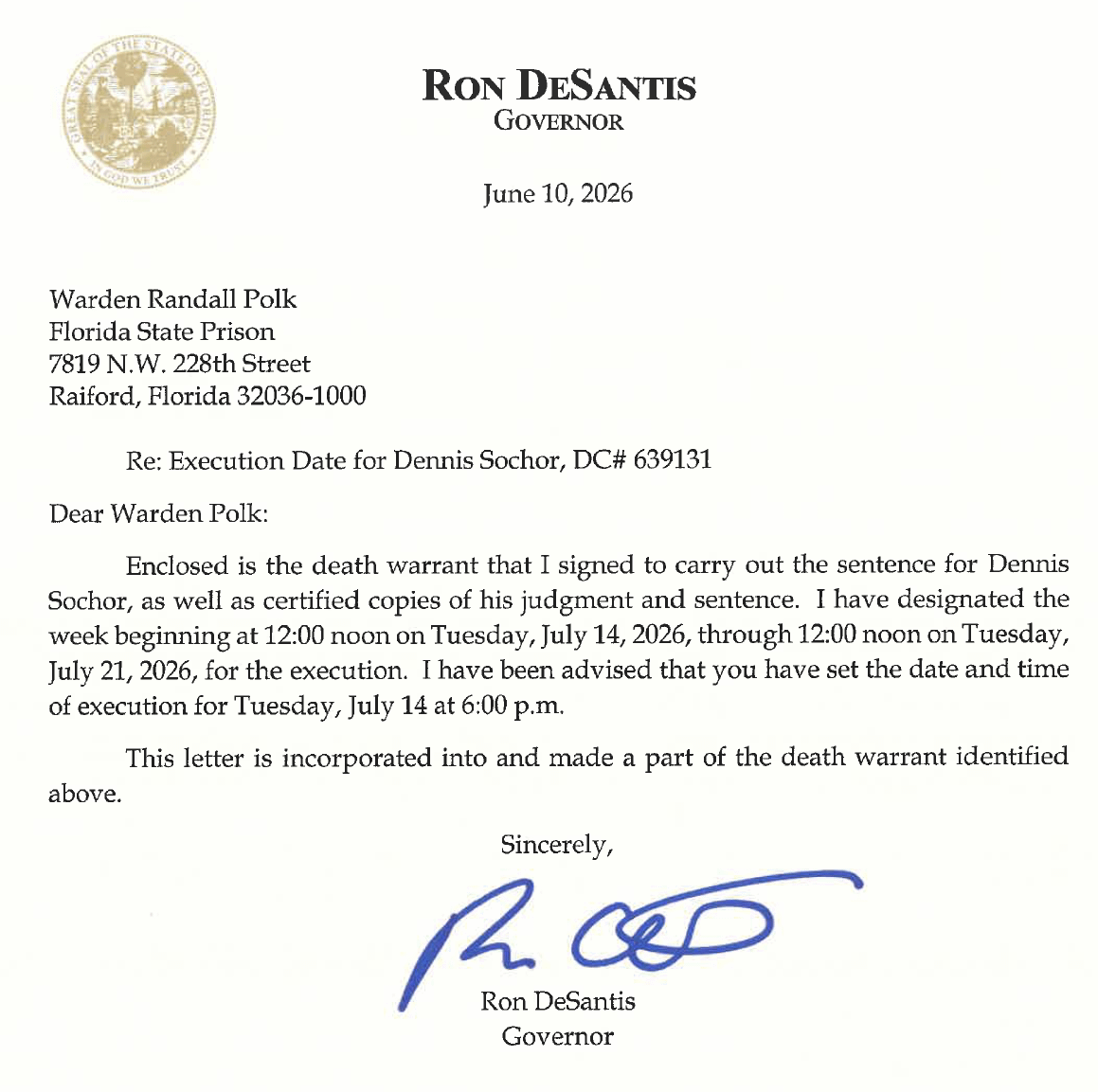
This afternoon, Gov. DeSantis signed a death warrant scheduling Dennis Sochor’s execution for July 14. It is the 11th death warrant signed so far this year.
Scheduling Order
Shortly after Gov. DeSantis signed the warrant, the Florida Supreme Court issued a scheduling order outlining the following schedule for warrant litigation:
June 26 at 11:00 a.m.: circuit court proceedings completed
June 26 at 1:00 p.m.: notice of appeal due
June 29 at 2:00 p.m.: initial brief due
June 30 at 5:00 p.m.: answer brief due
July 1 at 2:00 p.m.: reply brief due
Background
Trial & Direct Appeal
Sochor was charged with and convicted of first-degree murder for killing 18-year-old Patty Gifford on December 31, 1981, in Broward County. The facts were as follows:
[O]n December 31, 1981, the victim, an eighteen-year-old female, and a friend went to a lounge located in Broward county to celebrate New Year’s Eve. During the course of the evening the friend became ill. Sochor and his brother, Gary, helped the victim escort her friend outside to her car. Promising her that she would return soon, the victim returned to the lounge.
Early the next morning the friend awoke in the car, discovered the victim missing, and called the police. The police obtained a photograph taken that night which showed an unidentified man sitting at the bar near the victim. The photograph was shown on television, and, several days later, that man was identified as Sochor. The police talked with Sochor’s roommates who said that he had left suddenly when he saw his picture on television. They also told police that Sochor’s brother, Gary, had been visiting him and had recently returned to Michigan. The police interviewed Gary who implicated his brother in the victim’s disappearance and voluntarily returned to Florida to attempt to locate her body. In May 1986 authorities arrested Sochor in Georgia on an unrelated offense and extradited him to Florida where a grand jury indicted him on charges of first-degree murder and kidnapping. The victim’s body has never been recovered.1
Additional facts, written by the U.S. Court of Appeals for the Eleventh Circuit, are as follows:
Sochor lived in Fort Lauderdale, Florida, in 1981. Sochor’s brother, Gary, traveled from Michigan to Fort Lauderdale on the day after Christmas to visit him. At 6 p.m. on New Year’s Eve, the brothers drove a truck from Sochor’s apartment to a lounge called the Banana Boat.
Patty and her boyfriend also lived in Fort Lauderdale in 1981. Patty’s boyfriend had to work on New Year’s Eve so Patty and her friend, Delta Harville, decided to celebrate together. Their friend, Patricia Boreman, tended bar at the Banana Boat. They drove Delta’s car to the lounge at 9 p.m.
Patty and Delta sat at a tiki bar behind the Banana Boat. As they sat there, Boreman served Delta a few drinks. Sochor and his brother approached Patty and Delta and tried to talk with them. Sochor sat at the bar and talked with the women for a few hours. Someone took a photograph of Sochor sitting next to the women.
Delta had too much to drink. Patty, Sochor, and Gary took Delta to the parking lot and put her in her car. Patty then returned to the Banana Boat to pay her bar tab. When Patty came back to the parking lot, she determined that Delta was unable to drive. Sochor and his brother asked Patty if she wanted to accompany them in the truck to find something to eat while Delta slept in her car. Tragically, Patty accepted their invitation.
Sochor and Gary did not take Patty anywhere to eat. In a tape-recorded confession to the police that the prosecution played for the jury, Sochor stated that he and Patty had an argument. Sochor asked Patty if she wanted to have sex, and Patty said no. When Sochor grabbed Patty by the hair, she fought for her life. Patty screamed and scratched Sochor’s face. Sochor “got angry and began choking her.” When Patty stopped breathing, Sochor knew that he had “probably just murdered her.” After Sochor murdered Patty, he drove the truck down a dirt road “and placed her body in the weeds.”
Gary testified against his brother. Gary stated that, after they left the Banana Boat, the truck came to a stop and Sochor stepped out of it. Gary stated that he heard “Patty ... hollaring [sic] for help, asking what was going on.” Gary testified that he “got out of the passenger’s side, ran around the vehicle, and [saw that Sochor] had [Patty] on the ground, had [Patty’s] hands pinned down.” Gary threw a rock at Sochor and “hollared [sic] at [Sochor] to leave her alone,” but Sochor “told [him] to get back in the truck.” Gary did as he was told because he was scared of his brother. Gary testified that he never saw Patty again.2
The jury recommended death by a vote of 10-2, and the judge sentenced Sochor to death.
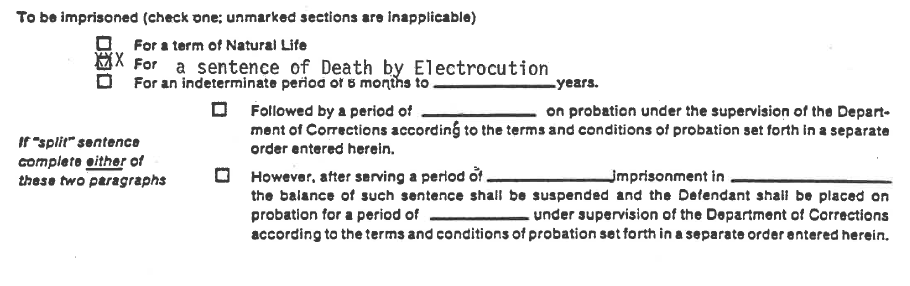
On direct appeal, the Florida Supreme Court affirmed Sochor’s conviction and, despite striking an aggravating factor considered by the trial court, affirmed his death sentence. However, in 1992, the U.S. Supreme Court “granted certiorari, vacated the sentence, and remanded the case, holding that [the Florida Supreme Court] failed to perform a harmless error analysis.”3 On remand, in 1993, the Florida Supreme Court affirmed Sochor’s death sentence, determining any error was harmless.4
Postconviction
After a limited evidentiary hearing, the circuit court denied Sochor’s postconviction motion. He appealed to the Florida Supreme Court, raising 10 issues:
(1) he received ineffective assistance of counsel at the penalty phase of his trial; (2) the State committed a Brady violation by not revealing that it had given Gary Sochor immunity in exchange for his testimony; (3) he received a constitutionally inadequate mental health evaluation; (4) the postconviction circuit court judge should have granted Sochor’s motion to disqualify himself; (5) several of his claims were improperly denied by the circuit court without an evidentiary hearing; (6) his trial counsel’s failure to object to certain jury instructions was ineffective assistance; (7) he is innocent of the death penalty; (8) the rules that prohibit lawyers from contacting jurors are unconstitutional; (9) the death penalty statute is unconstitutional; and (10) the cumulative effect of the errors at trial deprived him of a fair trial.5
He also filed a petition for writ of habeas corpus, raising five claims:
(1) that he received ineffective assistance of counsel on direct appeal; (2) that this Court did not conduct a proper harmless error analysis on remand from the United States Supreme Court; (3) that the instruction for the “heinous, atrocious, or cruel” aggravating circumstance was unconstitutionally vague; (4) that he did not receive a proper appeal because the appellate record was incomplete; and (5) that Florida’s capital sentencing statute is unconstitutional under Ring v. Arizona, 536 U.S. 584, 122 S.Ct. 2428, 153 L.Ed.2d 556 (2002).
In 2004, the Florida Supreme Court issued a decision finding that trial counsel’s performance was “clearly deficient” for failing to investigate and present mitigation regarding Sochor’s mental health in the penalty phase. The Court determined that “Sochor’s counsel put little time or effort into preparing expressly for the penalty phase.” However, the Court determined that the deficiency did not prejudice Sochor. The information that was presented at trial revealed:
[Sochor] was one of ten children; his father singled him out for repeated and brutal beatings; his mother also beat him; when he was four years old, he fell while running with a tin horn in his mouth and the tin horn went through the roof of his mouth; for a period of time when his father had been demoted at work, Sochor gave the family his paychecks; his parents noticed that he changed after he was discharged from the army—specifically, he became violent, especially when under the influence of alcohol; at one point, his parents thought he needed psychiatric help and were able to get him involuntarily committed to a hospital, but he was quickly released when the hospital told the family that although he needed psychiatric help, he was “not severe enough” to be kept there; and he attempted to commit suicide.
Finding that Sochor wasn’t prejudiced by counsel’s failures, the Court affirmed the denial of Sochor’s postconviction motion and denying his habeas petition.
Justice Anstead dissented, and Justice Pariente joined, arguing that Sochor was prejudiced by counsel’s deficient performance:
Among the factors that the majority overlooks is the fact that the death recommendation here, in spite of the incompetency of counsel, was not unanimous, and the fact that this Court itself later set aside the serious aggravator of CCP used to justify the sentence of death. In addition, the majority fails to acknowledge the quantitative as well as qualitative differences between the evidence presented by incompetent counsel at the penalty phase and the mitigation we now know existed but was not discovered or used. The majority has also mistakenly relied on the irrelevant guilt phase evidence of insanity and competency that was actually harmful to the defendant, to substitute for the mental health mitigation that was neither investigated nor presented at the penalty phase of Sochor’s trial.
Federal Habeas
Sochor filed a petition for writ of habeas corpus in federal court, which was denied in September 2009. Sochor appealed to the Eleventh Circuit, which addressed two issues: (1) “Sochor’s claim that he was prejudiced by his lawyer’s deficient investigation and presentation of mitigating evidence during the penalty phase of his trial,” and (2) “Sochor’s claim that the Supreme Court of Florida made unreasonable findings of fact when it denied his Brady and Giglio claims.”6 In June 2012, the Eleventh Circuit affirmed the denial of Sochor’s federal habeas petition.
Hurst
After the U.S. Supreme Court’s 2016 decision in Hurst v. Florida,7 Sochor sought relief based on the jury’s nonunanimous recommendation for death—a claim he had previously raised and was denied. His claim was denied because his sentence of death became final before 2002.8 Justices Pariente, Lewis, and Canady concurred in result.
TFDP Prior Coverage of Sochor’s Case
My thoughts are with everyone involved in the warrant- and execution-related process.
Sochor v. State, 580 So. 2d 595, 598-99 (Fla. 1991).
Sochor v. Sec’y, Dep’t of Corrs., 685 F.3d 1016 (11th Cir. 2012).
Sochor v. Florida, 504 U.S. 527, 540 (1992).
Sochor v. State, 619 So. 2d 285, 293 (Fla. 1993).
Sochor v. State, 883 So. 2d 766, n.7 (Fla. 2004).
Sochor, 685 F.3d at 1028.
Sochor v. State, 235 So. 3d 304 (Fla. 2018).