
DUCKETT WARRANT: Appeal filed to Florida Supreme Court
James Duckett’s execution is scheduled for July 28. On Friday, the circuit court denied his most recent postconviction claims without an evidentiary hearing, and Duckett appealed.
James Duckett’s execution has been rescheduled for July 28. On Friday, the circuit court denied his most recent postconviction claims without an evidentiary hearing, and Duckett appealed the ruling to the Florida Supreme Court.
Statement from Duckett’s Counsel
On July 15, Floridians for Alternatives to the Death Penalty released a statement from Duckett’s counsel that said in full:
We are disappointed by the Governor’s decision to set a new execution date for our client James Duckett after the State’s own decisions prevented a full and reliable evaluation that could have demonstrated his long-maintained innocence. It is particularly shameful that the Governor chose a date just two weeks away and set the execution on the very same day as the already scheduled execution of Dominick Occhicone.
After his first death warrant was signed in February, Mr. Duckett was granted DNA testing of biological evidence that had never been tested with modern forensic technology. Instead of ensuring the use of a test that would allow for the most complete analysis possible, the State insisted upon using a laboratory that it knew was not capable of performing the advanced Whole Genome Sequencing (WGS) test necessary to fully analyze this degraded DNA evidence.
The State alleged this choice was for speed, arguing in court that it has “a strong interest in not having the execution delayed,” and wanted testing to be completed “as soon as possible.” Their argument, however, ignored the expert who testified that his lab could do the necessary WGS testing as quickly, if not quicker, than the lab chosen by the State to perform an inferior test. Through their adamant refusal to allow no one but the Florida agency to perform the tests, the state destroyed the evidence most central to Mr. Duckett’s case by choosing a testing method and agency that they knew could not provide a definitive result.
Only when a stay of execution was issued by the Florida Supreme Court allowing additional litigation was Mr. Duckett allowed to receive the underlying data so that an independent expert could attempt the analysis that should have been done from the outset. By then, it was too late. Because the State’s chosen laboratory had used a testing method not designed for the type of forensic testing that was needed, and that consumed all of that limited sample, the expert was left with data than could not provide an inclusion or exclusion.
The inconclusive test results are a direct consequence of the State’s own decisions. They chose the laboratory, chose the testing method, and chose expediency over the truth of what happened to Teresa McAbee. Now, they seek to execute our client without the full truth ever being revealed.
Mr. Duckett has consistently maintained his innocence. The State’s duty is to ensure that justice is done, and not rush to kill in a case with such serious doubts over guilt. We are committed to seeking every avenue of relief for Mr. Duckett ahead of his scheduled July 28 execution so that the State of Florida does not execute an innocent man.
We urge Governor DeSantis to re-open the clemency process and fully evaluate the serious issues in the integrity of Mr. Duckett’s conviction.
July 16 Case Management Conference
On Thursday afternoon, the circuit court held a case management conference, where it addressed Duckett’s motion for an evidentiary hearing. Duckett’s counsel argued that they are in this position because the State “destroyed” the “best evidence.” They’re now “trying to determine how to remedy that” and believe the appropriate remedy is to allow further testing, which they believe would exonerate Duckett.
The State argued that Duckett’s claims should be denied without an evidentiary hearing. The State argued that Duckett has not adequately alleged a due process violation because it’s a statutory right to testing. The State further argued there is no dispute of fact (as Duckett’s counsel said there is) and that Duckett’s claim fails as a matter of law. The State’s counsel said, “It doesn’t matter what we’re fighting about” because Duckett’s claims fail as a matter of law. The State called Duckett’s requests a “fishing expedition,” “dilatory,” and “piecemeal litigation”
The State said it would file a short response to Duckett’s motion to stay by 6:00 p.m. Indeed, it did respond yesterday afternoon. The Court said it planned to enter an Order by July 17 at 5:00 p.m.
Circuit Court’s Order
On Friday afternoon, the circuit court entered an Order denying Duckett’s most recent postconviction claims without an evidentiary hearing and also denying Duckett’s request for additional DNA testing.
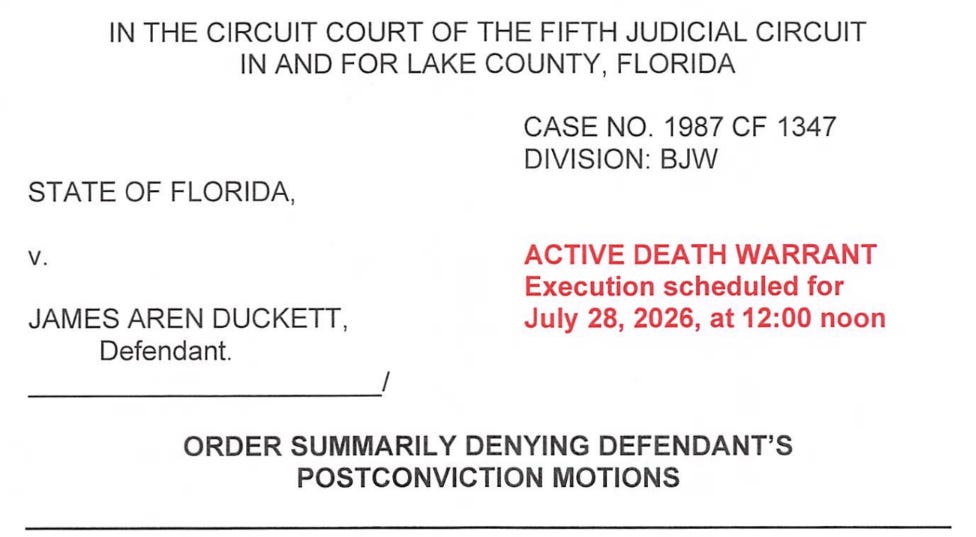
Postconviction Motion
In the Order, the court determined that Duckett could not show that the State destroyed evidence in bad faith, which is required for relief based on the State destroying evidence. The court reasoned that Duckett’s “claim of bad faith rests on the assertion that the testing method used ‘could not garner the necessary results,’” which “is contrary to Defendant’s position in its previous motions.” Further, the Court wrote: “Even after this Court ordered the testing to be performed by DLI using the Kintelligence testing kit, the Defendant consistently asserted that such testing could or would provide exculpatory evidence.”
Further, the court found that the caselaw upon which Duckett relied was not applicable because this case did not involve “a failure by the state to preserve evidence when it otherwise could have” but, rather, consumption was a necessary result of the testing.
The court also rejected Duckett’s due process argument, holding that Florida law does not “impose[] any specific procedural requirement for” determining the proper test.
DNA Motion
The circuit court also rejected Duckett’s motion for additional DNA testing that was previously tested in 2003. The court determined the claim is procedurally barred.
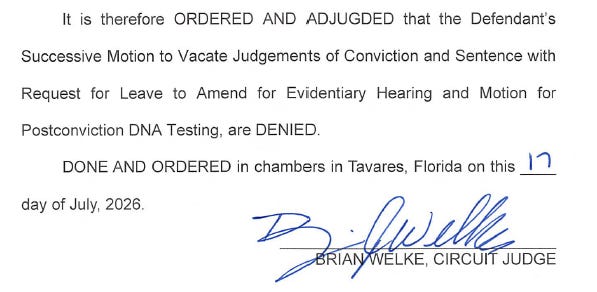
The full Order can be downloaded here.
Appeal to Florida Supreme Court
Friday evening, Duckett through his attorneys, filed an appeal of the circuit court’s Order. Shortly after, the Court issued a scheduling order with the following schedule:
11:00 a.m., Monday, July 20, 2026: record on appeal due
5:00 p.m., Monday, July 20, 2026: initial brief due (25 page limit)
5:00 p.m., Tuesday, July 21, 2026: answer brief due (15 page limit)
12:00 p.m., Wednesday, July 22, 2026: reply brief due (10 page limit)
You can view the filings in this appeal on the Court’s docket here.
TFDP Prior Coverage of Duckett’s Case
My thoughts are with everyone involved in the warrant- and execution-related process.